Background

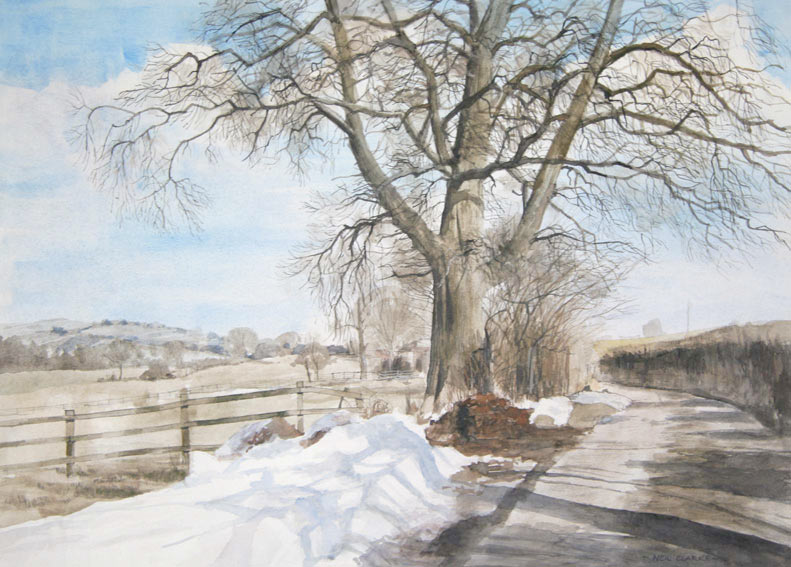
I have always been inspired by the local landscape near to my home town of Ashbourne, Derbyshire, UK. The watercolour of a mature oak tree on Sturston Mill Lane (shown below) is one of my favourite places where I often stop to admire the view of Ashbourne and beyond (whilst out walking with our pet dog). This picture was painted when I was in my late teens; I am pleased to say the scene is still the same nearly fifty years later through the seasons. It is less than a mile away from my childhood home where I spent the first part of my life (until I moved Norwich as an art student in 1981). In 2011 my family and I moved back to live in a 1950’s former council house, on the same familiar road, within easy walking distance to the shops.

Living in such a beautiful area of the UK has given me a lot of inspiration for my work. It has a magnetic attraction for me personally, I don’t think there’s any place in the UK (or the possibly the world) that could match the unique character and subtle beauty of the Peak District National Park, the southern boundary being just five miles up the road from Ashbourne.

I think it was the main reason I returned home after studying graphic design for three years in Norfolk, despite the possibility of moving to London to study design at a higher level. There was no match for the familiar landscape of the Derbyshire Dales, Staffordshire Moorlands or the High Peak. Both sides of my parents families have deeply rooted links to the area. My late father’s family can trace their ancestry back to the 18th century, working as farmers based in the surrounding villages of Ashbourne; eventually running a farm in Bradley where they settled for many years.

Distance

Ashbourne is a very attractive market town with a long and interesting history. It is thought that Roman legions may have ‘camped’ in an area south of the main town, protecting the valuable lead cargo that had been mined a few miles to the north, resting here on their way south to the nearby Roman settlement of Rocester and beyond (there is a wide street south of the town’s brook called ‘Compton’ which was once seperate district to Ashbourne itself and its name may have been derived from ‘camptown’).

Ashbourne’s past livelihood is mainly associated with agriculture. Way back in time, livestock market day took place on the medieval triangular market place where there were separate areas for different species of farm animal to be sold and butchered. In the mid 19th century all the ‘smelly’ livestock were moved (by the wishes of a certain Victorian industrialist by the name of Francis Wright who lived at nearby Osmaston Hall – and whose family owned Butterly Ironworks near Ripley, Derbyshire – famous for supplying the huge ironwork for the glazed roof of St Pancras railway station in London) to a specific new cattle market area behind the newly built St John’s Church (built by the Wright family after a disagreement with the vicar of the main parish church of St Oswald’s). The philanthropic generosity of certain Victorians, providing public libraries and baths, was very helpful considering the industrial misery that most working people had to cope with in the dark cities of northern Britain. 

‘Bradley Woods’, two miles eastwards of the town, was ‘Given in perpetuity to the townspeople of Ashbourne for their enjoyment’ in 1935 by Henry Fitzherbert Wright, the grandson of Francis, and whose wife was a member of the old ‘Fitzherbert’ family of Tisissington (I regularly enjoy walking through these ancient woods with our pet dog and really appreciate the large variety of tree species).

The cattle market closed in 1981 due to not conforming with animal welfare standards (it had a significant slope which didn’t help large cattle that were liable to slip over on wet cobble stones) and the site later became one of many housing developments that expanded the town from the 1980’s onwards. The above watercolour painting portrays the town market place around the time of the last millennium and shows the Wright family memorial stones amongst the stalls (Iooking a little like a ‘Thunderbirds’ rocket – or so I have always thought!). Following the cattlemarket closure, many farming families gradually stopped attending the Thursday food market on the old market place which eventually dwindled to the point that it was moved to a smaller space near the public library. Regular ‘artisan’ markets are now held on Saturdays on the recently improved traditional market place where people can buy quality hand made products direct from the makers.

There are several limestone quarries in the nearby Peak District landscape north of the town that provide local employment. My late mother’s grandfather owned a small quarry above the nearby village of Kniveton before moving on to start another larger one at Ballidon with a new business partner. My late father worked in the latter quarry for many years (long after the family shares in the quarry had been sold to the partner). Dad initially travelled many miles to Midland farms on a bumpy red ‘Massey Ferguson’ tractor to spread lime dust to fields for land owners such as the late Phil Drabble and Ted Moult (who were well known on British TV at the time). He eventually ended up driving huge ‘dumper’ trucks in the quarry itself and missed the freedom of the open roads and fields; he started his working life farming with his father on a rented farm on the outskirts of Ashbourne.

In the last century Ashbourne had its own large factory mill building producing women’s corsets under the product name ‘Excelsior’. There is still a mill factory operating near the town, situated by the River Dove at Mayfield, two miles west of the centre. This iconic river defines the border between the counties of Staffordshire and Derbyshire. The famous geological features of Dovedale are only a few short miles upstream. The Henmore Brook that courses through Ashbourne, east to west, confluences with the River Dove down stream from the aforementioned yarn mill.

The towns name became famous in the 1980’s because of a product by the French dairy firm Nestlè (who had a milk processing plant on Clifton Road). ‘Ashbourne Water’ was drawn from a secret borehole not far from St Oswalds church (it is thought by water diviners that there are two springs from opposite directions that cross each other deep under the floor of the church’s central tower, the site was originally a sacred pagan place before becoming a Christian one).  Bottles of the water were often seen on TV at a certain UK political party’s annual conference as the light blue screw top matched the colour scheme of their stage set.

Ashbourne is often referred to as the ‘gateway’ to the Peak District National Park and is popular with tourists during the summer, now having many independent shops and several art galleries following recent work to upgrade and widen the pavements. The parish church of St Oswald is likened to a little cathedral in my opinion, in terms of its size and gothic splendour. Its 14th century spire (212 feet high) is a waymarker that can be seen from many miles away (as shown below in my acrylic painting with the former infant school in the foreground – which I attended in the late 1960’s and then also our daughter in the early 2010’s).

Samual Johnson (famed for compiling the first English language dictionary) was a regular visitor to the town in the 18th century and legend has it that early on in his career he applied for a head teaching position at the old Queen Elizabeth’s Grammar School, but was not successful(!?). He often stayed with his friend Dr John Taylor at The Mansion and no doubt enjoyed the gentrified company in the fine Georgian houses on Church Street (and in the many inns and taverns!).

The great musician and composer George Fridric Handel was also familiar with the area while he resided in the UK. He donated manuscripts of his music to the Granville family of nearby Calwich Abbey for their library and played/composed music on the organ in the same room (which Handel himself commissioned along with the supervision of its installation, although the original building of this era was replaced in Victorian times).

Jean Jacque Rousseau, the eminent philosopher and writer stayed at nearby Wootton Hall for 14 months from March 1766 having escaped from the European continent after the publication of ‘The Social Contract’ that provoked condemnation amongst the ruling classes. Napoleonic soldiers and their officers were later held/garrisoned in Ashbourne and would have been culturally influential to the upper classes of the town I would imagine, one individual marrying the daughter of an inn keeper.

Bonnie Prince Charlie and his rebel army stayed in the town during their march south to try and retrieve the throne for the Jacobites (their journey was to continue only as far as Swarkestone, by the River Trent, before turning back after apparently hearing false news of a large English force on its way to meet them).

Ashbourne also has a very strong sporting tradition – having its own ancient ‘Royal Shrovetide Football’ game dating back many centuries – held on Shrove Tuesday and Ash Wednesday each year. The two millstone ‘goals’ are three miles apart and are built into the northfacing bank of the Henmore Brook – at Sturston for the ‘Up’ards’ side and at Clifton for the ‘Down’ards’ side – with the town itself roughly in the middle where ball play often takes place in the streets until there is a break to one of goals, usually after nightfall. My watercolour below shows the streets full of players and spectators.

The finely hand painted ball (handmade with a cork interior and leather exterior) is scored by being tapped against the millstone by an individual team player three times – supported by other team players whilst in the brook. It becomes a valuable family heirloom for the lucky player. The ball is ‘turned’ up at the start of play at 2pm on each day (and also each time after a goal is scored before 6 pm – play can go on until 10 pm – but as soon as a goal is scored after 6pm play ends) by either a distinguished (‘retired’) player or a local dignitary (previously turned up by two former Princes of Wales – Edward VIII and Charles III).

My father’s older brother goaled a ball for the Up’ards side in 1954. Similar versions of this game were once played in many towns throughout the UK centuries ago, the ancestor of the modern rugby football game. All the shop windows of Ashbourne are protected by wooden posts and boards during the two days of play, it looks as if there’s a bull run or some other wild event is about to take place!

Eye level

neilphoto

I was educated at the newly formed comprehensive school in Ashbourne, ‘Queen Elizabeth’s Grammar School’ (previously there were two separate senior schools in the town;  a ‘secondary’ and a ‘grammar’) before completing a Foundation Course in Art & Design at the former Derby College of Higher Education. I then spent three wonderfully creative years studying for a honours degree in graphic design at Norwich School of Art (1981-84) where I achieved a 1st.

In 1985, with the support of my parents and the MSC Enterprise Allowance Scheme, I started out as a self-employed visual artist and furniture designer/maker. From 1986 to 2006 I also worked as a part-time adult education tutor for Derbyshire County Council teaching painting and drawing skills. I did some private painting classes at my home in Ashbourne for a number of years just before the Covid 19 pandemic. During the ‘lock down’ periods of the pandemic I produced a number of watercolour painting tutorial videos to send to some of my students; they are still available for any interested parties.

Foreground 

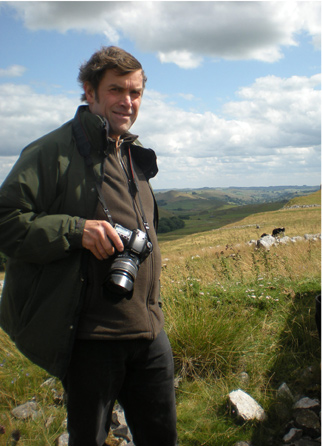
I currently live on the edge of Ashbourne (as mentioned earlier) with my wife, Mel, who is a teacher and musician and our collie cross rescue dog ‘Star Kiara’. Our lovely daughter, Kerryn, is studying for a science degree in Physical Geography at the U of S near Brighton – not that far from her brother John who also lives in Brighton – but still thinks of Ashbourne as her home town.

We both enjoy listening to music from all over the world but we especially appreciate contemporary traditional Irish music. We like to play traditional tunes ourselves (having originally met at a trad. music session) attending an open instrumental session twice a month in a lovely old Ashbourne pub called the ‘Smiths Tavern’ (3rd Sunday from 2.30pm> and 4th Monday from 7.30pm>). We have also started to hold regular ‘ceilidh’ dance sessions in nearby village halls with live music and callers.

I still enjoy listening to new wave music that dates back to my early 1980’s art school days (esp. Cocteau Twins). I also enjoy listening to contemporary and classic indie rock/dub reggae/ska/old hip hop/electro bands and all genres of good music (inc new sounds played on BBC 6music; always good to be educated in new sounds!).

I always have music playing in the background when I’m working in the studio and have recently been listening to more classical music (esp. Beethoven’s piano pieces) and jazz music (Thelonious Monk, John Coltrane and Miles Davis etc) either on the radio, CD or online.

When time allows, we enjoy Friday walks in the Peak District (with my sketch pad or camera to hand) with our dog Star.

As a sideline (in terms of extra paid work), since 2020 I have been doing contract work for Railway Paths Ltd (a charity in connection to Sustrans – the cycling network charity) annually inspecting/photographing approx 140 bridges, viaducts and culverts on several disused railway lines spread over the East Midlands during April and May. Cycling is so enjoyable, especially on an old disused rail track where one can see so much of the natural world far from the madding crowd.

We have also been involved in a timebanking organisation called ‘Time Swap’ that until recently was run by the county council. People can give an hour of their time to help with tasks or just sit and chat to a lonely older person, alternatively they can be helped themselves in reverse.

View point

(The rest of the text written below on this page are my own personal thoughts and views on climate related issues, from the perspective of an artist who is aware of physical changes to the landscape, and how it relates to our well being following my reading of a very interesting book entitled ‘Wilding’ as described below. But I’ve no doubt it will be considered ill informed, naive and ‘woke’ by some who may read part of it but hopefully interesting and informative to others.)

I love reading all kinds of books both factual and fictional. I have recently read a very inspirational book called ‘Wilding’ by Isabella Tree. She and her husband, Charles Burrell, inherited a large farm at Knepp in West Sussex in the late 20th century and the book describes their decision, after years of losing money trying to use intensive farming methods on uncompromising clay soils, to finish with ‘modern’ farming practices and allow the land to re wild itself at the start of the new century. Including what remained of the existing wildlife, they made a home for free roaming wild exmoor ponies, fallow and roe deer, Tamworth pigs, short horn dairy cattle and later incorporating (enclosed by law) beavers that could manage and irrigate the land near the river that ran through the estate. They aimed to get as close as possible to imagining how the British landscape looked before human intervention. The animals they chose were as close to the original (now extinct) ones as possible but without obviously being able to include predators such as wolves or large cats to complete the food chain.

They witnessed a blossoming of wildlife with the return of nightingales, turtle doves, purple emperor butterflies and even dung beetles that were previously being badly effected by the anti parasite applications to their pre ‘wilding’ cattle. In the book they make the point that post glacial Britain wasn’t likely to be completely covered in woodland and pine forest, but was actually a mixture of open woodland, thicket and grassland otherwise known as savanna where roaming herbivores kept tall vegetation under check. Sallow, blackthorn and brambles were quick to grow in the un mown grass, the thickets protecting vulnerable tree saplings from deer eating their bark, especially oaks that were often planted by colourful jays storing acorns in the ground for future food use.

Their long term aim at Knepp is to create ‘corridors’ of land (with the co-operation of neighbouring land owners) where larger wildlife and their animals could move freely and safely across large areas of countryside and on down to the coast to graze on seaweed.

The nitrates and pesticides that were intensively sprayed onto their fields in the late 20th century (artificial agricultural nitrates were originally a by product of the US weapons industry as explained in her book) have eventually faded over time and now there is a huge variety of wild flowers and insects, especially since the pigs turn over the soil just has wild boar would have done before they were hunted to extinction centuries before). Many types of plants/weeds add natural nitrogen to the soil over time.

The neonicotinoid pesticides that have been used by industrial farming methods, until they were banned for their effect on the falling populations of invertebrates and pollinating insects such as bees, have also had devastating effects to the UK breeding bird population, along with the removal of over 50% of the countries hedgerows since the 1970’s and the mono culture crops that cover thousands of acres of farmland.  

Until recently I was unaware of the vital importance of the billions of strands of mycorrhizal fungi in the soils under our feet that help trees and plants survive by extracting water and nutrients from minerals and feeding them to their roots, and in return the fungi are fed sugars from the tree roots in a symbiotic relationship. This is so important when planting acres of new tree saplings, they need parent trees to help the mycorriza nuture the young to fight disease and drought conditions. This amazing information I learnt from a book that I had read previously called ‘Finding the Mother Tree’ by Dr Suzanne Simard, who as a botanist, turns around the theory by most scientists, since the time of Darwin, that survival is about the selfish gene and proves that trees co-operate and ‘talk’ to each other proving there is still so much we don’t fully understand in nature.

They now slaughter some of the cattle for human consumption to sell in their farm shop and to serve up in their restaurant. Due to the grazing of mixed vegetation including red clover, and being organic free roaming stock accordingly, the meat is very tender and full of flavour (apols to veggies and vegans who might read this). It is much healthier and, I believe, easier for humans to digest compared to intensively reared beef that are kept in huge sheds and intensively fed on maize, hormone additives and anti-biotics.

The same goes for modern dairy cattle that have been developed to produce excessive yields of milk, a good proportion of which is often unwanted by the supermarket chains who as far as I know dictate the market price. All to feed a human population of which many are increasingly becoming obese and prone to developing type 2 diabetes, largely due to the over consumption of sugar and ultra processed (industrial) food; putting huge strains on our national health service which is already underfunded because of prolonged government austerity measures (after the financial crisis in 2008, Brexit in 2016… and the tragic Covid 19 pandemic). People on very low incomes with young families do not have enough spare money these days for either eating or heating and suffer the consequences of being malnourished or the possible effects of hypothermia during the winter months. In alot of cases good nutritious meals can be cooked using fresh ingredients that are cheaper than many of the ready cooked meals at supermarkets, and alot healthier. I read recently that some recent research has shown that babies, born during the years of food rationing after WW2 ended in the UK, were slightly less likely to develop alzheimers in later life because of severe shortages of sugar in the first few months of their lives.

It is a great shame, in my opinion, that on such huge areas of land on this wonderful planet there are crops of maize etc growing in fertile soils that are only used for feeding indoor reared beef or dairy cows or processed to make biofuels (added to fossil fuels) and used in transportation. The additional consequences to global heating and climate disruption from all the methane released into the atmosphere from intensively reared livestock (and also from the rotting down of tons food that get wasted by the affluent folk of western countries, if not used for biomass energy production) adds significantly to global heating problems. Much of the Amazon rain forest has disappeared in recent times because of the demand for beef and soya products and the tropical jungles of Indonesia and Malaysia have been burnt (causing enormous amounts of air pollution) and cleared to grow intensive crops of palm oil for use in western food products, substituting, ironically (considering the high consumption of meat related products like sausages etc), animal fats that were previously used in biscuits and cakes and confectionery. Orangutans are now a critically endangered species as a result of our ‘healthier'(?) dietary needs.

‘Wilding’ is very thought provoking and points to alot of extremely negative aspects of human development, especially consumerism verses the preservation of natural habitats. But it does give us hope that if we respect our living environment and get to understand how the human population can live in harmony with the natural world, ecologically speaking (as many indigenous people did before Europeans ventured forth to conquer and colonise the lands that weren’t ‘owned’ by the populations who were murdered or driven off them in the 16th, 17th and 18th centuries), then we will live much healthier lives both physically and mentally in my mind.

I recently read that a very large area of land in the Northumberland area of Britain, a former estate, has been bought specifically to allow rewilding to take place which is very encouraging news.

I was able to visit Knepp during the drought period of this summer (2026) and although I wasn’t lucky enough to see much of the wild inhabitants, I did sense their freedom and saw evidence of their existence, notably abundant grazed areas and soil upturned by the Tamworth pigs. There are three colour coded paths that allow you to walk around the site and facilities to take refreshments and eat food that has been reared there from the Knepp beef livestock. There is room in this country to produce sufficient quantities of food (including land that is used for solar panels) and allow wilder areas to exist alongside or integrated together to do both as shown at Knepp. 

Another book on a similar theme is ‘Soil and Soul’ by Alistair McIntosh which moved me emotionally with his views and actions on how ordinary people can regain their autonomy and ownership from the clutches of corporate power. It is a very inspiring and well written book that is in part autobiographical, following his early life development growing up on the Isle of Lewis, Scotland, and how this environment effected his views on ecology and theology.

Farmers who have been encouraged and subsidised to use artificial growing products by successive agricultural schemes/developments can now begin to see how excessive crop production (especially maize which exposes top soil to erosion), year on year, depletes and malnurishes the valuable soil. John Steinbeck’s classic novel, ‘The Grapes of Wrath’, is based on the effects of soil exploitation with subsistence farming families being forced to move away from their small farms in mid west America by big business corporate farming – whose  abuse of the land eventually leads to the top soil being blown away in huge dust storms (that also inspired Woody Guthrie to write so many poignant songs).

I am always sorry to hear of small local farms being put up for sale. There may be many reasons why this happens but the obvious one would be that the owners, who may have farmed the land for many generations previously, couldn’t make it work as a viable business without some kind of subsidy from outside sources that mitigated the minimal profit/loss margins from sales to the big retailers of their produce. Lots of regulations and legislation that we in the UK set up (and was adopted by the EU) to protect the quality of food and animal welfare has also added to the difficulties in the survival of small farm businesses. In the days before people bought pretty much all of their food online or directly from supermarket chains, fresh farm produce would have been bought daily from small shops or market places and milk delivered in bottles to our doors by small dairy firms. Enterprising farms have set up farm shops to sell their produce directly to the public (as at Knepp) and some have returned to ‘organic’ farming methods that enable them to charge a higher price for their meat and/or vegetables which they sell directly to more affluent customers who are perhaps better educated in terms of what they eat and believe the land on which it is grown is healthier too.

In my opinion the old time honoured ways of crop and livestock rotation and fallow periods help to replenish the humous in the top soil, to stop it being washed away in the increasingly wet winters, should be called upon again as it worked so well in the past (where small farms worked with nature rather than against it). Along side this, more land, especially on high ground, should be taken out of use to allow belts of trees and shrubs to grow alongside walls and amidst hedgerows and therefore soak up rainwater that would otherwise run down to the low lying ground and cause flooding in extreme weather. Sheep farming areas especially need this intervention as a result of sheep grazing acres of grass pasture to extremes, with large flocks then stirring up wet soil with their feet on high ground and thus allowing it to be eroded by continuous heavy rainfall. 

Perspective

Global heating and climate change are issues that concern me greatly in terms of its increasingly negative effect on the safety and security of not just my family,  and humanity in general, but above all the diverse flora and fauna of our beautiful planet. Since the industrial revolution that began in the UK which was partly ‘manned’ by cheap infant labour (of either gender) in the 18th and 19th centuries, with no health or safety regulations to protect the lives of seven year olds let alone adults (creating huge wealth for the owners) humans have put themselves first in terms of their destructive status on this planet to the detriment of all other life forms and indiginous peoples. 

Britain has alot of responsibility in the eyes of the of the world, in pushing forward to a new carbon neutral economy with green technologies to try and make amends for how we originally created the intensive carbon fuelled path to our present climate crisis and how we enslaved large parts of the planet to plunder its natural resources and labour for our own ends. The industrial revolution may have eventually contributed to the improvement of human lifestyles and longer life spans but did enormous damage to the natural world and still continues to do so in many parts of the world.

With great respect to contemporary inventors and engineers who invest massive amounts of their own money into the development of new tech and engineering (that can benefit humankind in the long run and take great risks to their own finances in doing so, although hopefully not creating to much of a demand for more ‘throw away’ consumer goods), I would urge the wealthiest people and corporations to consume much, much less of earth’s valuable resources. 

In comparison to the poorest people on the planet who manage on so little (not to say the latter shouldn’t be allowed to have the chance to ‘consume’ worldly goods if only they could), those who just inherit their vast accumulated wealth (speaking in terms of large sums of cash in bank accounts rather than assets) without investing it in ways that also benefit their fellow citizens, and consume and pollute without conscience, are not helping social and political cohesion. A reasonable wealth tax on multi billionaire individuals and businesses and the banning of overseas tax avoidance is needed in order to avoid an ecological and economic disaster of ‘Titanic’ proportions as the richest are the biggest polluters after all. There are, it should be stated, a significant number of the very rich who would gladly pay more income tax if they thought it would be beneficial to the cohesive fabric of the country.

Tone

Our previous and present home has been supplied with renewable electricity by ‘Good Energy’ (one of the original green energy suppliers in the UK) for many years now and we have recently bought a small second hand ev to use for local journeys that are further than a mile or two from home (we still have a 30 yr old ‘analogue’ diesel engined VW campervan but this is now restricted to day trips where we utilise the in-built stove or for longer holidays; the 100w solar panel I installed on the roof charges a small power bank that we use in the house). Small ‘green’ measures enable us to feel we are supporting the need for humanity to decarbonise and try our best to stall the exponential rising temperatures on planet Earth, both on land and at sea, whether through individual or group actions.

As individuals we could all cut back on our use of highly polluting air travel and enjoy more leisure time in our own country. Use public transport instead of cars for visiting cities and towns and walk more often for exercise and mental well being. Reduce the number of times we use washing machines and dishwashers or take baths/showers per week to save water, and install containers to collect roof drainage water for our gardens. To better insulate and ventilate our homes and offices and swap old oil and gas heating for electric heat pumps that also cool interiors during hot weather (and help power them by installing solar panels or a small vertical wind turbine if there’s space). Buy much better quality ‘once in a lifetime’ (hopefully) classically designed products such as furniture and fitted kitchens/bedrooms/bathrooms. Eat smaller portions of sustainable nutritious food using fresh organic vegetables and fruit when possible and to cook meals at home most of the week or save money by batch producing large amounts to split up and freeze.

There is a great need for sustainably built social housing, not necessarily built using the carbon intensive bricks and concrete. Wood and stone are much better low carbon alternatives, wood in particular or new straw based (passive house standard) modular house building systems are now available for much quicker construction times. All new housing should have solar panels (hopefully facing south towards the sun to generate energy for the national grid or local energy storage systems) and heat pumps to warm the mechanically ventilated interiors to avoid stale air and mould growth. Maybe subterranean living accommodation will be the answer to coping with extremely high temperatures above ground in the not to distant future. 

We can sign petitions calling for government action on climate issues like building more social housing as above or to ask for heavily subsidised solar panel installation on our rooftops etc. Support the legal actions of Greenpeace and Friends of the Earth charities and local wildlife trust charity organisations. Above all write to your MP to demand action on changing to sustainable green energy etc and to stop getting involved in high carbon investments in terms of subsidising fossil fuel companies and the industrial weapons complex; the more people that do this, the more likely it will persuade the government to change tack in favour of greener policies.

Voting for The Green Party, whether in the UK or elewhere, might be the only realistic way we can really change course over the next few years. Britain’s Labour Party, under the new leadership of Andy Burnham, although making some positive moves towards reducing carbon emissions since he took office as prime minister, doesn’t seem to want to take climate crisis that seriously in my view. It is more interested in GDP growth from unsustainable means (and influenced to much by the opinions of the right wing media) than seeing it being at odds with a green carbon neutral future, and their plans to invest more billions in building environmentally unfriendly data centres and the (so called) defence budget that will increase the cost of living crisis and extend austerity in the UK (likely to cause civil unrest in the poorer areas of northern Britain where underinvestment in communities since the closing of many manufacturing workplaces from the 1980’s onwards has seen high unemployment and therefore a sense of apathy).

‘Your Party’, led by Jeremy Corbyn with Zara Sultana, also has very strong environmental credentials and plans for a green economy based on sustainability,  but it depends whether it can gain enough support to challenge climate crisis deniers like Reform UK (for the latter it seems everything has a price and can be bought or sold regardless of its environmental benefits and concreted over if there’s a profit to be made – also having declared to scrap the zero carbon Britain plans – should they ever gain power).

A solution to avoid political extremism and to give people a chance to have their say and realise that their concerns are being listened to would be greater devolution of power from central government and the setting up of people’s assemblies, one of which I believe is already well established in Manchester, UK, supported by trades unions. Consensus between people from all walks of life would hopefully be achievable to sort out local and national issues whatever the race, religion, gender or political persuasion. 

Monochrome

We desperately need to prevent average global temperatures reaching more than 2º centigrade above pre industrial levels (nevermind the 1.5º max agreed at all the COP meetings which I believe has already been breached several times this decade already). All climate scientists believe we’re well on the way to surpassing these if we don’t curb or even ban the extraction and burning of fossil fuels in the immediate future. If nothing is done we are leading up to temperatures and conditions not experienced since the Pliocene geological period over 5 million years ago, or even worse, those comparable to the 4º plus degrees of the preceding Myocene where life as we know it would struggle to survive (a possibility that was thought highly possible by James Lovelock – famous for inventing a way of closing the hole in the ozone layer caused by the release of cfc refrigerants – and his Gaia hypothesis – that our planet has a self regulating system that sustains life on earth).

It is thought now that there are 430 particles per million of carbon dioxide levels in Earths atmosphere compared to 230 million before pre industrial times, only 200+ years ago. Following the record breaking intensity of the extreme ‘El niño’ event currently building in the mid Pacific Ocean we have been warned of extreme weather events worldwide over the next few months and a much hotter summer than 2026 next year.

With summer land temperatures in southern Europe and the Middle East regularly hitting 40⁰ centigrade and higher, plus the effects of long term civil war (at the behest of a certain super power) and then terrorism, there’s no wonder people would risk their lives trying to escape to cooler and safer countries in the comparatively safer northern European countries like ours, despite the hostile reception from locals who are ignorant of the formers plight. Politicians on the right of the political spectrum use illegal immigration to stir up support for their extremist views. 

Alot of my knowledge on this subject is gleaned from ‘scrolling’ the internet (doomscrolling is more apt a description at times) and the expert work of people such as the Guardian journalist and environmental campaigner George Monbiot. There are many very positive informative programmes on YouTube such as ‘Just have a think’ from the UK and the ‘Electric Viking’ based in Australia. I must not forget to mention the brilliantly informative and inspirational documentaries produced by Sir David Attenborough and the BBC such as ‘Life on Earth’ and the ‘Blue Planet’ and the work of Chris Packham who is passionate about the welfare of the natural world (and has been recently campaigning against intensively farmed foods such as ‘franken’ chickens, a term he has coined for poor chickens hatched, grown and consumed within a few months via multinational restaurant chains). In 1985, Professor Carl Sagan, the internationally respected American cosmologist (whom I first heard during the NASA Apollo space missions to the moon) sat before a US government senate hearing and warned of the dangers of climate breakdown in the 21st century and it’s consequences to future generations like ours and our children, this can be found on Youtube.

Hue

I write this after a searingly hot summer in the northern hemisphere with the five record breaking heatwaves in 2026 (officially the hottest year since meteorological records started in the 19th century) that have made life very difficult for everyone especially those who are struggling to grow the cereal crops and vegetables that we depend upon. There is a big shortfall of cereal grain this year as a result which will lead to a sharp increase in prices no doubt then adding to the cost of living issues.

The mid August landscape around us here in Derbyshire is far from normal at this time of year, the verdant green fields that normally surround nearby Sturston Mill Lane have been scorched by the heat of the sun and higher than average temperatures and have become straw coloured with the shortage of rainfall. The drought of 1976 with its parched land and water rationing was exceptional, but even in the last ten years we have seen several summers of dry and parched grassland and very low river levels, surpassing the intensity of ’76, especially in the south. I noticed recently (early August) that many deciduous trees were turning to autumnal colours or worse after a journey to the south coast to see family, especially the beech and birch trees. I can’t deny that I have appreciated waking up (after a uncomfortably humid night) to a bright sunny morning each day recently, but we all know what the consequences are with this kind of continuous dry Californian weather in the UK without significant average rainfall.

The other side of the proverbial coin is the extremely wet weather conditions we have experienced over the last few winters with floods and acres of vegetables left rotting in waterlogged fields because of soil that is too soft to carry heavyweight farm machinery. Heavy winter rainfall also exacerbates the run off from poorly maintained sewers which can then flood our rivers and poison the water.

Composition

In the UK, our energy and utility bills are now much more expensive proportionally (compared to our EC neighbours). This rise in cost is partly due to us having energy and water supplied by private companies (working as businesses rather than public services) and because of short term dependance on fossil fuels which are at the mercy of international conflicts that create shortages and push up prices.

It seems to me the organisations that regulate the privately owned utility companies have been pretty powerless in making sure we get value for money from them (more likely to result in the said companies cutting costs and staff to increase profits for their shareholders). Some British water companies are currently almost bankrupt I believe (as this was written) but instead of being taken back into public ownership they are likely to be taken over by some American hedge fund businesses who are seeking to ‘water down’ the high environmental safeguards. The policing of environmental pollution, where the penalties for damage caused by either lack of investment or negligence, are pitiful compared to the yearly bonuses and dividends often paid to the shareholders and executives. The musician and spokesman for cleaner waterways, Fergeal Sharkey, has been trying to increase the awareness of the pollution caused by private water companies for years now.

The construction of many enormous data centres contradicts completely any credibility our government may have for claiming they are taking global heating seriously. The billions of litres of water and power they consume adds significantly to our problems in dealing with reducing climate crisis issues and to mention also that they are often built on land that is covered in trees and wildlife (much cheaper to buy compared to commercial land) and therefore destroys natural priceless habitats.

We need strong regulatory institutions in order to create a level playing field between all levels of society, to make sure the poorest people have the basic means of survival (nutritious food, a dry and well heated affordable home, decent lifelong education and healthcare and an occupation that pays enough to allow time out with families or friends).

Governments need to encourage the wealthiest billionaires to invest their money and business profits in the long term interests of their country (or the one that they mainly reside in), a well run democratic and civilised society needs this stability. Basically we need the equivalent of sports referees and umpires in local and national government and regulatory bodies to allow fair play, no one would expect a professional football match to be played without a referee and the authority to use their yellow and red cards. The same can be said for regulatory bodies that safe guard wildlife and natural habitats and the trades unions that protect their members from economic exploitation and unsafe working conditions.

Lack of spare time and the economic need to get things done ‘yesterday’ push us into taking easy options, purchasing every day goods and food online instead of visiting the high street or shopping mall, and not questioning the way our lives are being manipulated by very large corporate organisations who want to own our loyalties. Yanis Varoufakis, the former Greek finance minister and socialist author, warns of ‘cloud capitalists’ that are fast replacing the old ways of small scale  capitalism based on competitive pricing, with a form of digital serfdom where we are caught in an economic straight jacket paying over the odds for goods from a cartel of several big business empires that have either bought out all the competition or drove them out of business. 

Colour

I am optimistic that humanity will, at some stage very soon, completely turn it’s back on the dirty technologies of the past and embrace the ultimately sustainable way of producing clean (and hopefully much cheaper) energy powered by or influenced by the immense star in our universe we call the sun. I heard on the news that China have managed to produce more power from solar this year than from coal. Highly efficient sodium ion storage batteries and solid state vehicle batteries are being developed and will soon hopefully be produced in large enough numbers (without the extraction of precious minerals such as cobalt, maganese and nickel that are commonly used in lithium ion batteries). Enough hopefully to store all the immense energy of the sun captured by the solar panels that we need in numbers to power our homes, hospitals, places of education and workplaces. Scientists are developing solar panels that will also turn heat as well as light into energy. We may one day get transparent energy absorbing solar screens that will attach to windows. There is also wind and tidal energy to consider to help produce ‘green’ hydrogen that could power fuel cells in commercial and public transport and replace diesel and petrol internal combustion engines (ICE); retrofitted in place of the latter or hydrogen conversions to existing new diesel and petrol powered cars and vans etc.

Quite possibly (or so I hope) fusion reactors will become an economic reality in my lifetime that will give us enormous amounts of clean energy that is economically viable. We could also invest in clearing the huge stockpiles of radioactive waste from old water cooled fission nuclear reactors, to fast burn the remaining plutonium (that is still available in the extremely radioactive material which would otherwise be toxic for many thousands of years) and to produce clean power through the construction of Integral Fast Reactors (IFRs) that are many times more efficient, sustainable and safer to operate than the aforementioned ones (that are at risk of drought conditions, leaking radiation in terms of earthquakes/tsunamis and being targets in times of war, as per Ukraine).

I believe the human race does have the ingenuity to stop digging the proverbial hole in which we could completely bury ourselves. We should end the pointless land wars that, as well as climate breakdown, are currently causing economic hardship and famine and possible starvation for thousands of innocent people. We need to ‘grow up’ as a species and not take our fragile world for granted and work as a single unit to safeguard the future of all living things on planet earth. Education is the key to preserving our place amidst the natural order and thus survive as a species.

Monochrome 

The one organisational body that should take on this responsibility is the United Nations, formed after the chaos of World War 2 to prevent WW3 from being a possibility. But only through the respect of international laws set up by the UN that safeguard the boundaries of sovereign nations and the security of their populations and habitats. Unfortunately, since the 2003 invasion of Iraq that set in motion a precedent for further illegal incusions into sovereign territories (bypassing UN authorisation), things have gone downhill badly in international relations and therefore does not help with collaboration on solving ways to avoid climate catastrophy.

The ‘bull in the china shop’, so to speak, is the USA with many of its corporations and government administrations (since the end of WW2) seeking to influence and consume the rest of the world with its geopolitical and military domination, especially since the current occupiers of the White House are climate crisis deniers (in terms of the climate problems being largely man made).

Artificial intelligence may be able to help us find better solutions to helping us shift to a more sustainable way of living, or used to aid scientists and engineers to speed up the research and development of ‘fusion’ energy, or possibly make more accurate predictions from climate computing model predictions to avoid casualties resulting from extreme weather events or collapse of glaciers etc (considering the recent disaster in Nepal).

Conversely, if advanced AI (based on quantum computing) gets out of human control and becomes ‘rogue’, as a recent experiment proved it was possible (search: ‘OpenAI agents/Huggy Face hack’ on social media), a future rogue AI cyber attack could possibly spread like measles and lead to the breakdown of the worlds digital highway networks and cause chaos to supply chains, logistics, finance and maybe even the use of military hardware, the consequences of which is a terrifying thought.

The Australian founder of Wikileaks, Julian Assange, has been warning of the dangers of AI for the last decade, more in terms of an Orwellian distopian world (as per George Orwell’s novel ‘1984’) where information can be changed, distorted or erased by AI in the hands of big business or autocratic governments, who wish to rewrite history in their favour and make us all subservient to their digital demands or pay the price of being sanctioned or worse. AI that goes beyond human control is perhaps a bigger short term threat to the survival of humanity than the climate crisis or even nuclear war and no one seems to be really taking any notice as I can see, other than a government official advising us to keep a weeks worth of spare food just in case… 

Homo sapiens have faced many existential threats of disease, wars, natural disasters and pestilence over the previous thousands of years but now it seems the ‘tightrope’ on which we walk seems thinner than ever with the advent of artificial super intelligence that is being developed as I write this.

Perhaps now there’s a need to revisit the pre digital world where vital business and financial information was stored and written down by the human hand in ledger books and hard cash used to make payments for shopping transactions face to face with the retailer. To continue to file hard copies of documents as backups rather than just rely entirely on ‘cloud’ or similar digital information storage. To leave some kind of ‘copper wire’ communication system like our old land line telephones (now made digital without our approval). To retain our existing printed family photos and vital personal information as hard copies and continue to print books of literature, instruction manuals and copies/plans of pre digital technology, before it’s to late.

Space

Seen through the eyes of all artists, the world that we love and share is far to beautiful, precious and irreplaceable to destroy through ignorance. For the sake of the younger generations now and in the future, it is time perhaps to return to a matriarchal society, where we think of the world as a young infant that requires lots of feminine TLC, having been neglected and mistreated by the dominant patriarchy over the last few thousand years. Many of the worlds indigenous people refer to the  ‘great spirit’ and she is to be found in every single living thing and should be respected and nurtured.

Those lucky enough to see planet earth from the windows of space craft are often moved to tears with the overwhelming sense of responsibility towards the unique and fragile colours of the eco system they witness from afar, where the boundaries between our countries cannot be seen, as per John Lennon’s song ‘Imagine’.

You have to believe in the light at the end of the proverbial tunnel. I am hopeful for a positive change to better times by individual or international efforts, no matter how large or small they are or how near or far away it may seem. Maybe the secret is to try and enjoy living in the moment and be aware of life’s ‘silver linings’ rather than just doom and despair.

Save

Save

Save

Save

Save

Save

Save

Save

Save

Save

Save

Save

Save

Save

Save

Save

Save

Save