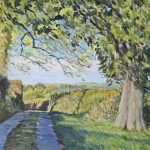
I have always been inspired by the local landscape near to my home town of Ashbourne, Derbyshire, UK. The watercolour of a mature oak tree on Sturston Mill Lane (shown below) is one of my favourite places where I often stop to admire the view of Ashbourne and beyond (whilst out walking with our pet dog). This picture was painted when I was in my late teens; I am pleased to say the scene is still the same nearly fifty years later through the seasons. It is less than a mile away from my childhood home where I spent the first part of my life (until I moved Norwich as an art student in 1981). In 2011 my family and I moved back to live in a 1950’s former council house, on the same familiar road, but much nearer to the town centre shops than before.
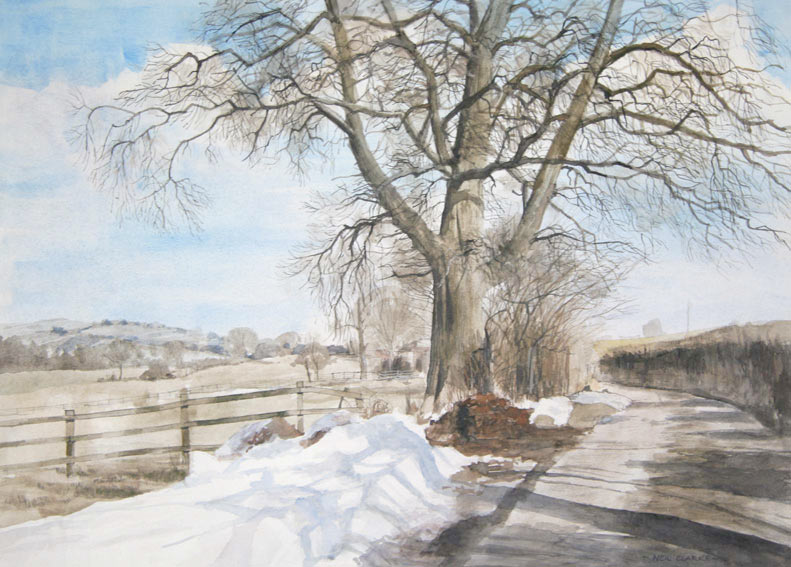
Living in such a beautiful area of the UK has given me a lot of inspiration for my work. It has a magnetic attraction for me personally, I don’t think there’s any place in the UK (or the possibly the world) that could match the unique character and subtle beauty of the Peak District National Park, the southern boundary being just five miles up the road from Ashbourne.
I think it was the main reason I returned home after studying graphic design for three years in Norfolk, despite the possibility of moving to London to study design at a higher level. There was no match for the familiar landscape of the Derbyshire Dales, Staffordshire Moorlands or the High Peak. Both sides of my parents families have deeply rooted links to the area. My late father’s family can trace their ancestry back to the 18th century, working as farmers based in the surrounding villages of Ashbourne; eventually running a farm in Bradley village where they settled for many years.
Distance
Ashbourne is a very attractive market town with a long and interesting history. It is thought that Roman legions may have ‘camped’ in an area south of the main town, protecting the valuable lead cargo that had been mined a few miles to the north, resting here on their way south to the nearby Roman settlement of Rocester and beyond (there is a wide street south of the town’s brook called ‘Compton’ which was once seperate district to Ashbourne itself and its name may have been derived from ‘camptown’).
Ashbourne’s past livelihood is mainly associated with agriculture. Way back in time, livestock market day took place on and around the medieval triangular market place where there were separate areas for different species of farm animal to be sold and butchered. In the mid 19th century all the ‘smelly’ livestock were moved (by the wishes of a certain Victorian industrialist by the name of Francis Wright who lived at nearby Osmaston Hall – and whose family owned Butterly Ironworks near Ripley, Derbyshire – famous for supplying the huge ironwork for the glazed roof of St Pancras railway station in London) to a specific new cattle market area behind the newly built St John’s Church (built by the Wright family after a disagreement with the vicar of the main parish church of St Oswald’s). The philanthropic generosity of certain Victorians, providing public libraries and baths, was very helpful considering the industrial misery that most working people had to cope with in the dark cities of northern Britain.
‘Bradley Woods’, two miles eastwards of the town, was “Given in perpetuity to the townspeople of Ashbourne for their enjoyment” in 1935 by Henry Fitzherbert Wright, the grandson of Francis, whose wife was a member of the old ‘Fitzherbert’ family of Tisissington (I regularly enjoy walking through these ancient woods with our pet dog and really appreciate the large variety of tree species).
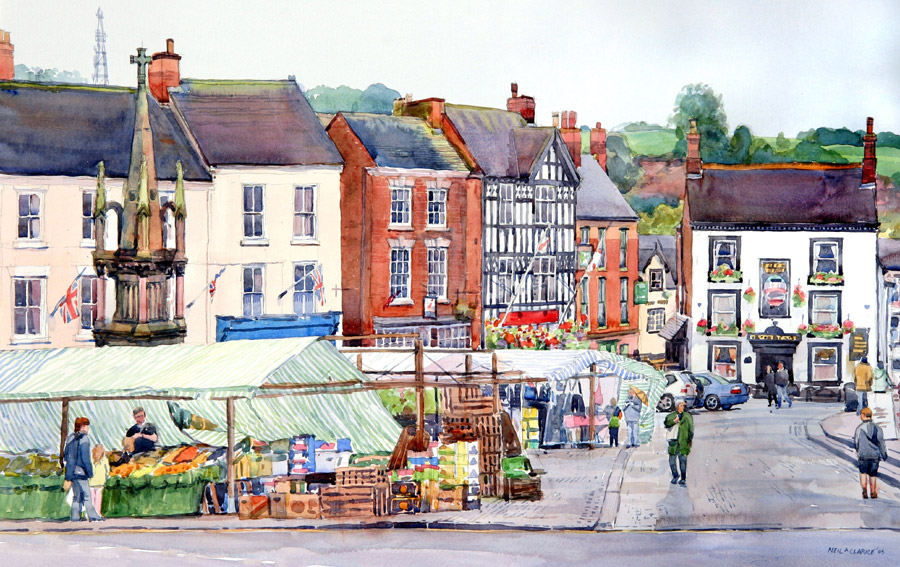
The cattle market closed in 1981 due to not conforming with animal welfare standards (it had a significant slope which didn’t help large cattle that were liable to slip over on wet cobble stones) and the site later became one of many housing developments that expanded the town from the 1980’s onwards. The above watercolour painting portrays the town market place around the time of the last millennium and shows the Wright family memorial stones amongst the stalls (Iooking a little like a ‘Thunderbirds’ rocket – or so I have always thought!). Following the cattlemarket closure, many farming families gradually stopped attending the Thursday food market on the old market place which eventually dwindled to the point that it was moved to a smaller space near the public library. Regular ‘artisan’ markets are now held on Saturdays on the recently improved traditional market place where people can buy quality hand made products direct from the makers.
There are several limestone quarries in the nearby Peak District landscape north of the town that provide local employment. Very large articulated tanker lorries travel through Ashbourne daily with their cargo of calcium carbonate, a number of these travel to France. My late mother’s grandfather owned a small quarry above the nearby village of Kniveton before moving on to start another larger one at Ballidon with a new business partner. My late father worked in the latter quarry for many years (long after the family shares in the quarry had been sold to the partner). Dad initially travelled many miles to Midland farms on a bumpy red ‘Massey Ferguson’ tractor to spread lime dust to fields for land owners such as the late Phil Drabble and Ted Moult (who were well known on British TV at the time). He eventually ended up driving huge ‘dumper’ trucks in the quarry itself and missed the freedom of the open roads and fields; he started his working life farming with his father on a rented farm on the outskirts of Ashbourne.
In the last century Ashbourne had its own large factory mill building producing women’s corsets under the product name ‘Excelsior’. There is still a mill factory operating near the town, situated by the River Dove at Mayfield, two miles west of the centre. This iconic river defines the border between the counties of Staffordshire and Derbyshire. The famous geological features of Dovedale are only a few short miles upstream. The Henmore Brook that courses through Ashbourne, east to west, confluences with the River Dove down stream from the aforementioned yarn mill.
The towns name became famous in the 1980’s because of a product by the French dairy firm Nestlè (who had a milk processing plant on Clifton Road). ‘Ashbourne Water’ was drawn from a secret borehole not far from St Oswalds church (it is thought by water diviners that there are two springs from opposite directions that cross each other deep under the floor of the church’s central tower, the site was originally a sacred pagan place before becoming a Christian one). Bottles of the water were often seen on TV at a certain UK political party’s annual conference as the light blue screw top matched the colour scheme of their stage set.
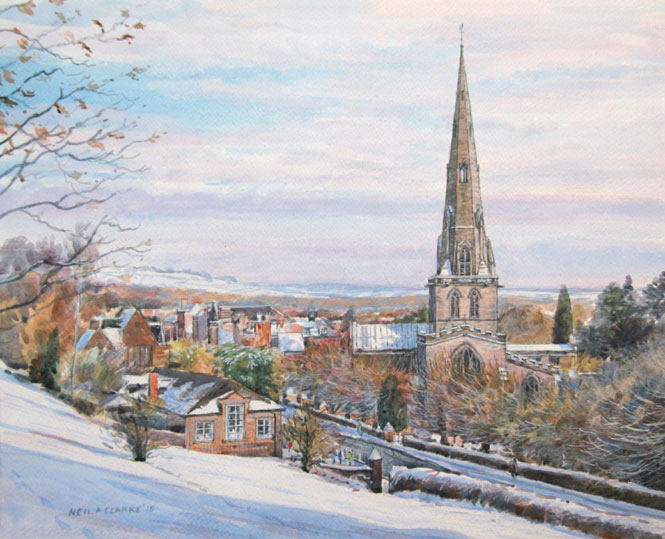
Ashbourne is often referred to as the ‘gateway’ to the Peak District National Park and is very popular with tourists during the summer. Its name derives from ‘ashes by the brook’ and it now has a growing number of independent shops and art galleries following recent work to upgrade and widen the pavements. The parish church of St Oswald is likened to a little cathedral in my opinion, in terms of its size and gothic splendour. Its 14th century spire (212 feet high) is a waymarker that can be seen from many miles away (as shown below in my acrylic painting with the former infant school in the foreground – which I attended in the late 1960’s and then also our daughter in the early 2010’s).
Samual Johnson (famed for compiling the first English language dictionary) was a regular visitor to the town in the 18th century and legend has it that early on in his career he applied for a head teaching position at the old Queen Elizabeth’s Grammar School, but was not successful(!?). He often stayed with his friend Dr John Taylor at The Mansion and no doubt enjoyed the gentrified company in the fine Georgian houses on Church Street (and in the many inns and taverns!).
The great musician and composer George Fridric Handel was also familiar with the area while he resided in the UK. He donated manuscripts of his music to the Granville family of nearby Calwich Abbey for their library and played/composed music on the organ in the same room (which Handel himself commissioned along with the supervision of its installation, although the original building of this era was replaced in Victorian times).
Jean Jacque Rousseau, the eminent philosopher and writer stayed at nearby Wootton Hall for 14 months from March 1766 having escaped from the European continent after the publication of ‘The Social Contract’ that provoked condemnation amongst the ruling classes. Napoleonic soldiers and their officers were later held/garrisoned in Ashbourne and would have been culturally influential to the upper classes of the town I would imagine, one individual marrying the daughter of an inn keeper.
Bonnie Prince Charlie and his rebel army stayed in the town during their march south to try and retrieve the throne for the Jacobites (their journey was to continue only as far as Swarkestone, by the River Trent, before turning back after apparently hearing false news of a large English force on its way to meet them).
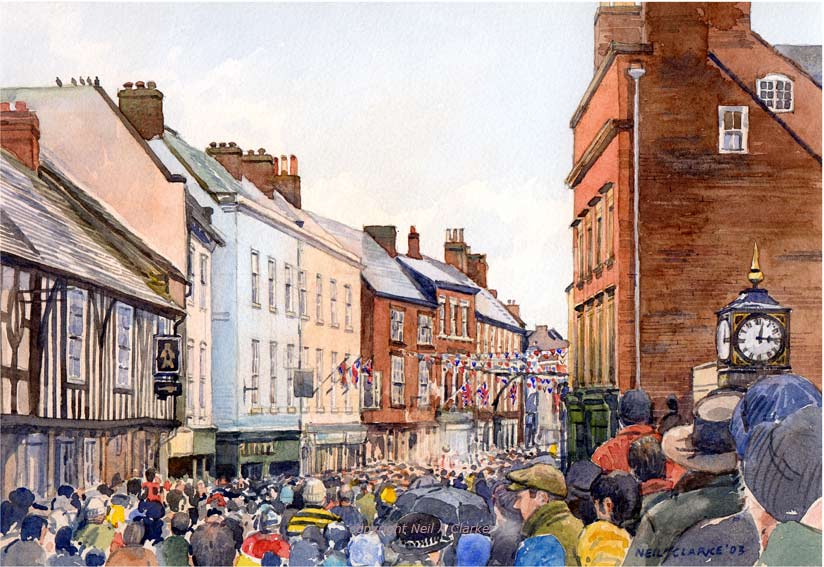
Ashbourne also has a very strong sporting tradition – having its own ancient ‘Royal Shrovetide Football’ game dating back many centuries – held on Shrove Tuesday and Ash Wednesday each year. The two millstone ‘goals’ are three miles apart and are built into the northfacing bank of the Henmore Brook – at Sturston for the ‘Up’ards’ side and at Clifton for the ‘Down’ards’ side – with the town itself roughly in the middle where ball play often takes place in the streets until there is a break to one of goals, usually after nightfall. My watercolour below shows the streets full of players and spectators.
The finely hand painted ball (handmade with a cork interior and leather exterior) is scored by being tapped against the millstone by an individual team player three times – supported by other team players whilst in the brook. It becomes a valuable family heirloom for the lucky player. The ball is ‘turned’ up at the start of play at 2pm on each day (and also each time after a goal is scored before 6 pm – play can go on until 10 pm – but as soon as a goal is scored after 6pm play ends) by either a distinguished (‘retired’) player or a local dignitary (previously turned up by two former Princes of Wales – Edward VIII and Charles III).
My father’s older brother goaled a ball for the Up’ards side in 1954. Similar versions of this game were once played in many towns throughout the UK centuries ago, the ancestor of the modern rugby football game. All the shop windows of Ashbourne are protected by wooden posts and boards during the two days of play, it looks as if there’s a bull run or some other wild event is about to take place!
Eye level
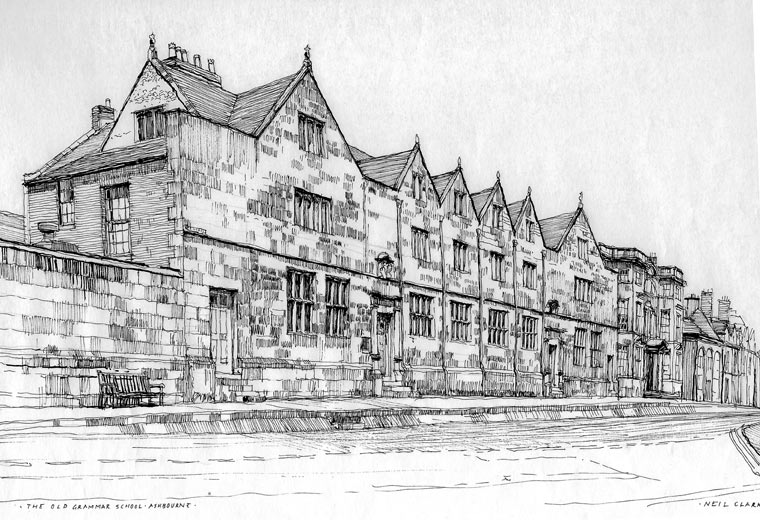
I was educated at the newly formed comprehensive school in Ashbourne, ‘Queen Elizabeth’s Grammar School’ (previously there were two separate senior schools in the town; a ‘secondary’ and a ‘grammar’) before completing a Foundation Course in Art & Design at the former Derby College of Higher Education. I then spent three wonderfully creative years studying for a honours degree in graphic design at Norwich School of Art (1981-84) where I achieved a 1st.
In 1985, with the support of my parents and the MSC Enterprise Allowance Scheme, I started out as a self-employed visual artist and furniture designer/maker, with the latter taking up the majority of my creative time over the years. From 1986 to 2006 I also worked as a part-time adult education tutor for Derbyshire County Council teaching painting and drawing skills. I did some private painting classes at my home in Ashbourne for a number of years just before the Covid 19 pandemic. During the ‘lock down’ periods of the pandemic I produced a number of watercolour painting tutorial videos to send to some of my students; they are still available for any interested parties.
Foreground
I currently live on the edge of Ashbourne (as mentioned earlier) with my wife, Mel, who is a teacher and musician and our collie cross rescue dog ‘Star Kiara’. Our lovely daughter, Kerryn, is studying for a science degree in Physical Geography at the U of S – not that far from her big brother John’s house in Brighton.
We both enjoy listening to music from all over the world but we especially appreciate contemporary traditional Irish music.  We like to play traditional tunes ourselves (having originally met at a trad. music session) attending an open instrumental session twice a month in a lovely old Ashbourne pub called the ‘Smiths Tavern’ (3rd Sunday from 2.30pm> and 4th Monday from 7.30pm>). We have also started regular ‘Ceilidh’ dance sessions in two nearby village halls with live music and dance callers (four times year or so), Mel plays keyboard in our local band (of 5 members) and I have started to learn some of the dance tunes on mandolin (by ear as I can’t read music notation alas) to join them on stage, an ambition I’ve had ever since I saw the great flim ‘Local Hero’ filmed on the coast of Scotland. The Ashbourne Ceilidh Band is available to play at charity ceilidhs.
I still enjoy listening to new wave music that dates back to my early 1980’s art school days (esp. Cocteau Twins). I also enjoy listening to contemporary and classic indie rock/dub reggae/ska/old hip hop/electro bands and all genres of good music (inc new sounds played on BBC 6music; always good to be educated in contemporary sounds as there are many great new original bands around despite the many cover bands that dominate venues!).
I always have music playing in the background when I’m working in the studio and have recently been listening to more classical music (especially Beethoven’s five piano concertos as played by András Schiff) and classic fifties jazz music either on the radio, CD or online.
When time allows, we enjoy Friday walks in the Peak District (with my sketch pad or camera to hand) with our dog Star.
As a sideline (in terms of extra paid work), since 2020 I have been doing contract work for Railway Paths Ltd (a charity in connection to Sustrans – the cycling network charity) annually inspecting/photographing approx 140 bridges, viaducts and culverts on several disused railway lines spread over the East Midlands during April and May. Cycling can be very enjoyable, especially on old disused rail tracks where one can see so much of the natural world that is far from the madding crowd, and most are pretty level of course with very slight gradients!
Mel and me have also been involved in a local version of timebanking called ‘Time Swap’ that is run by a charity directed by the county council. People can give an hour of their time to help with skilled tasks/repairs or to simply just sit and chat to a lonely older person for an hour or so, conversely they can be helped themselves using their time bank credits.
My wife and I are very interested in sustainability and the preservation of what little wildlife we have left in our county or in our country for that matter. As parents (and now more recently grand parents thanks to our John and George adopting), we want to see a more progressive type of governance with the emphasis on empathetic and reciprocal relations between all members of society. In the face of so many existential challenges that are currently effecting us, there is a need to pull together and work together to realise that our lives on this planet are not sacrosanct and life cannot be taken for granted, especially if we treat fellow humans and our environment which such disrespect.
We are members of Derbyshire Wildlife Trust and recently attended their AGM at Heage Common Farm near Belper. DWT bought the farm in 2024 and are in the process of rewilding the grassland to achieve a haven for many species of wildlife, to link up with other areas in Derbyshire that they manage. Common Farm was once ‘common land’ where grazing was available to anyone who owned or tended livestock before being ‘enclosed’ as private land as a result of the Enclosure Act of 1801. They aim to expand the neighbouring Bessalone wood into the adjoining fields and then have a percentage of scrubland inc blackthorn, bramble etc for good nesting locations. But most of the grassland will be kept and maintained by the nearest living equivalent of long lost animals such as auroch, wild boar and tarpans that moved into the UK area after the last ice age period. Definitely worth a visit and defo worth supporting the trust for all the good work it does in supporting our local wildlife.
A similar rewilding took place at the turn of the century on a much larger farm in West Sussex at Knepp. The inspiring story of this change of land use can be found in a book called ‘Wilding’ by Isabella Tree who talks about the amazingly quick reappearance of creatures that are/were close to extinction due to industrial farming practices that used artifical fertilisers and pesticides such as neonicatinoids. The returnees included turtle doves, purple emperor butterflies and many other threatened butterfly species, nightingales and even dung beetles (that have been badly reduced in numbers because of the infestation treatments given to modern farm livestock but have fundamenital roles to play in the good health of soil along with earthworms). An excellent thought provoking read if you are a person who loves nature and the great outdoors as well as being a beautiful place to visit to witness the free roaming short horn cattle, fallow and roe deer, Tamworth pigs, Exmoor ponies, enclosed beavers, white storks and the many species of wildlife with three colour coded walks within the estate (and with refreshments/ food available and products that have been grown there).
Another fascinating book to read in terms of the natural world is ‘Finding the Mother Tree – Discovering the Wisdom of the Forest’ by Dr. Suzanne Simard. As part of her early academic research she finds evidence of the symbiotic relationship between mycorrhizal fungi below the surface of soil and the trees that grow above. The fungi feed the trees with moisture and minerals from the soil and rocks and the trees feed the fungi with sugars from the sap in their roots. It is quite inspiring to think of the caring and sharing relationships in nature which the human race must be aware of in order to survive on the wonderfully exotic planet we ‘all share’.
‘Braiding Sweetgrass’ is a beautiful book about our reciprocal relationship with the natural world written by Dr Robin Wall Kimmerer, a botanist and member of the Citizen Potawatomi Nation. As an indigenous scientist she explains the close relationship her people have with mother earth and how we should appreciate all the gifts of nature, small or large, that we depend upon to survive but never take for granted.
A similar theme runs through a very moving book by Alistair McIntosh (a respected Scottish theologian and environmentalist) called ‘Soil and Soul’. It is semi autobiographical, following his formative years growing up on the Isle of Lewis in the Outer Hebrides and the spiritual impression the island made on him also being the son of a Scottish Minister. He describes the history of the infamous ‘Clearings’ where populations were physically moved from the western highlands and islands of Scotland by the new English ‘landowners’ to be replaced by sheep (mainly to produce wool for soldiers uniforms) in the years after the arrest and murder of the old Scottish clan chiefs following the defeat of Bonnie Prince Charlie Stewart and his Jacobite army at Colluden in 1746.
The book details how Alistair McIntosh played a major role in the monumental process of enabling the beleaguered population of the Isle of Eigg to set up a trust for the island and legally establish their security (and force its negligent English landlord to sell). He also, with the help of an indigenous North American warrior chief, managed to deter a quarrying company from removing a huge mountain on the Isle of Harris through their determined efforts to oppose corporate powers who are willing to cause environmental degradation in their pursuit of commercial profit. There is alot of humour amongst the serious issues discussed in this book and it should be part of any serious collection of printed environmental collections.